
Sitting a case study
OCS, MCS/Gateway or SCS. Pre-seen and industry analysis, timed mocks with professional marking, FinnAI and live classes.
See the case study packs4x CIMA Global Pass Rate Excellence Award, 2022 to 2025
Pre-seen analysis, timed mocks marked within 48 hours, plus FinnAI and TutorBot whenever you are stuck.
To FinnAIWhat are the biggest issues in this pre-seen?
To TutorBotQuiz me on chapter 5, exam style.
To RevisionBotExplain IFRS 16 like I have never seen it before.
Free mini course
Rated 4.9 by students on Trustpilot
Three days of free lessons. Enrolling for November 2026 and February 2027.
Given by CIMA for our students' pass rates, every year since 2022. Tap a certificate to see it.
Our students work at


Three tools, each trained on Finntutors' own material.
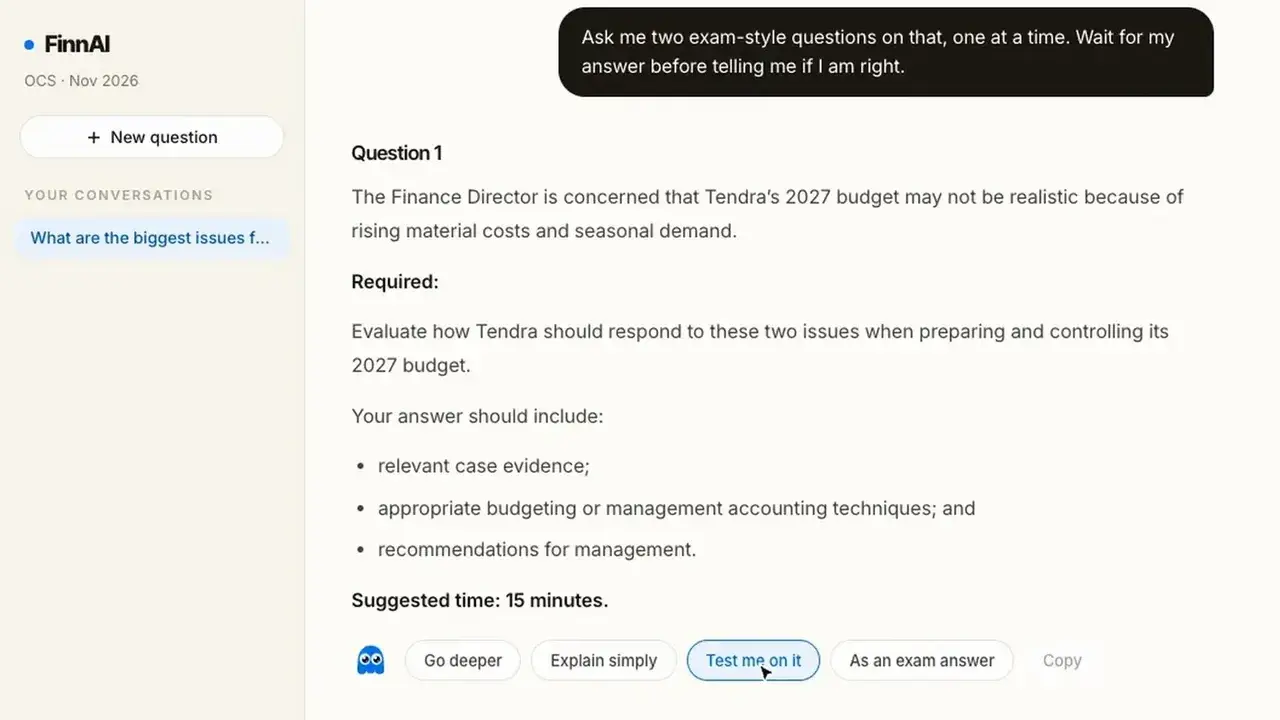
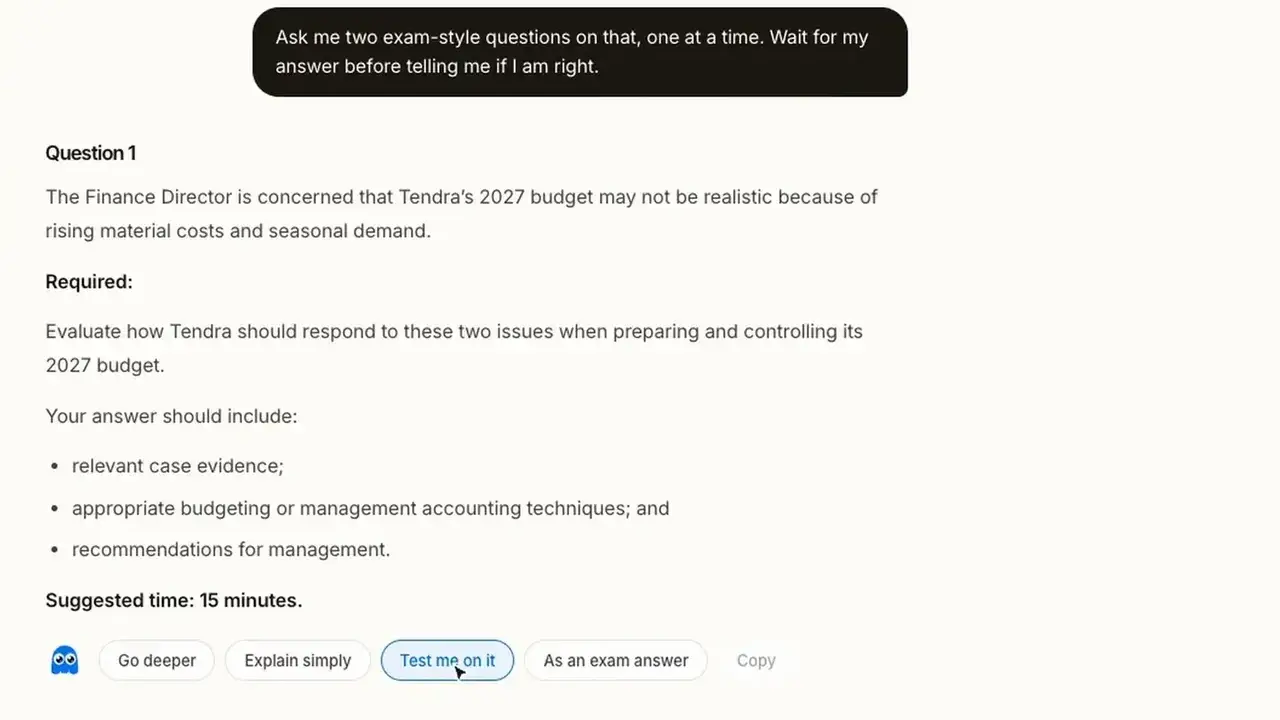
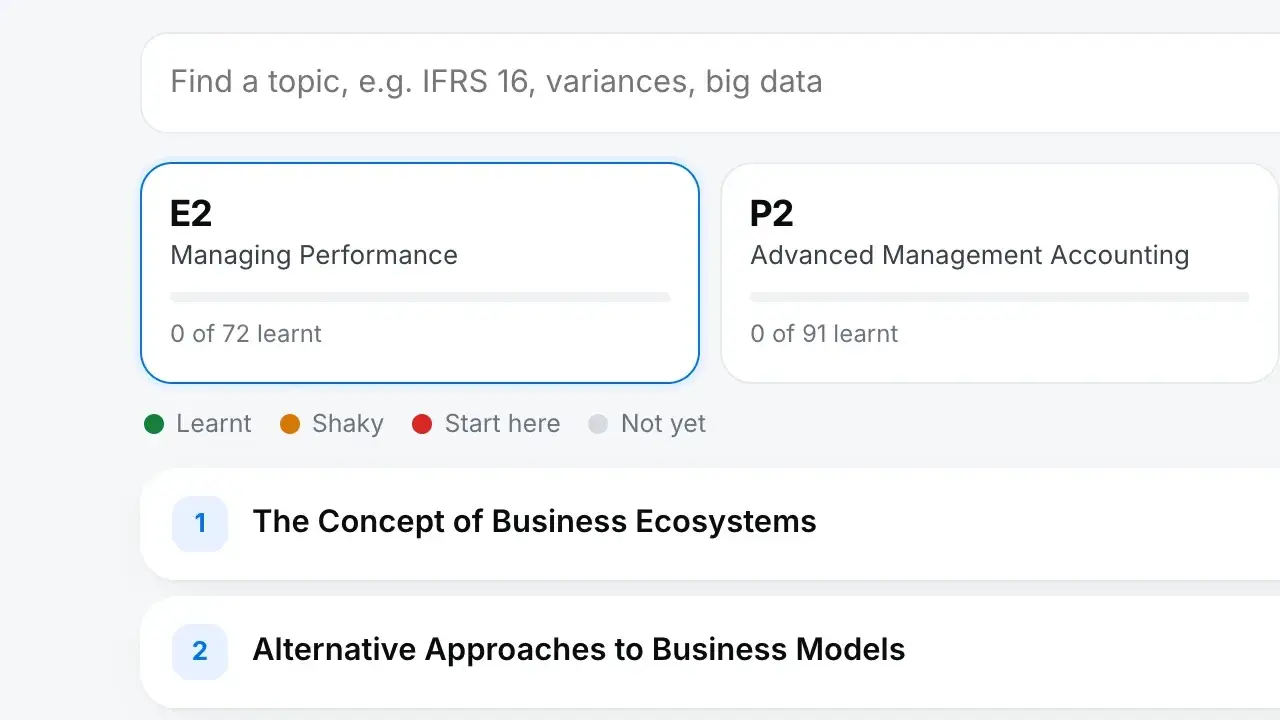



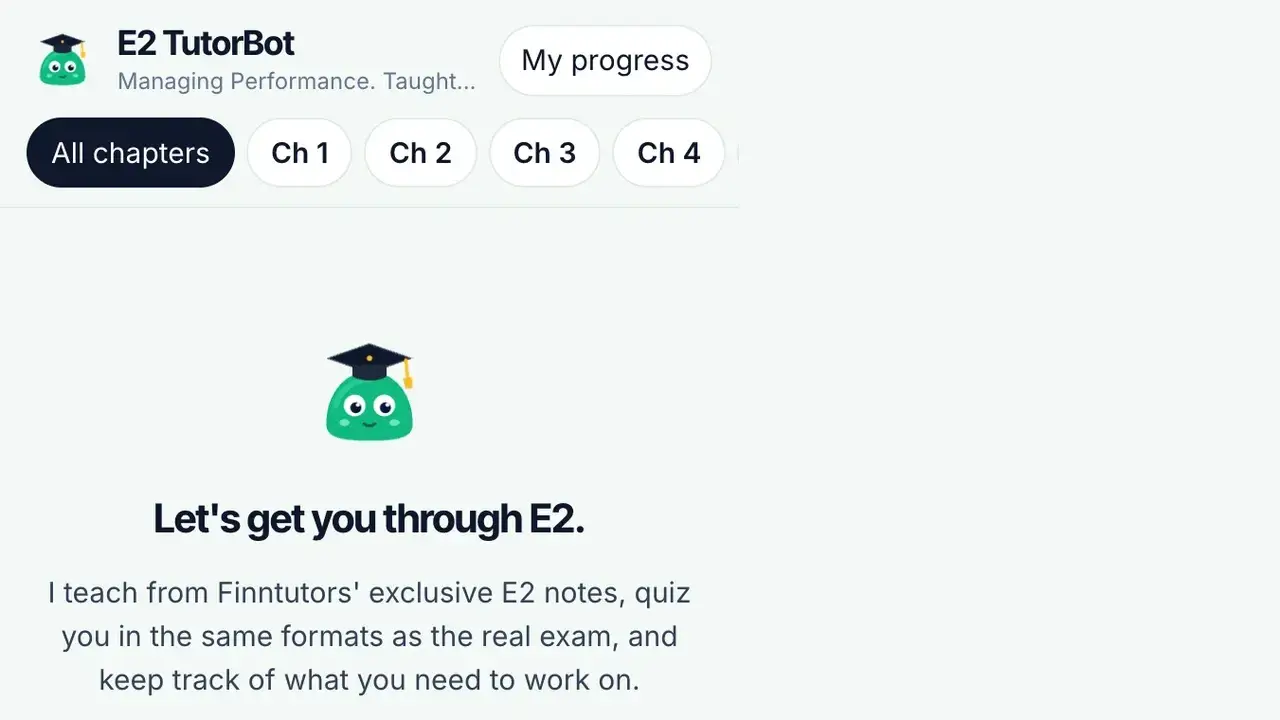

Trained on our pre-seen and industry analysis. Ask about the company, the numbers or exam technique, then ask it to test you.
Included in every case study packIdeal if you have exemptions. One topic at a time: it explains plainly, lets you try, and checks you can explain it back.
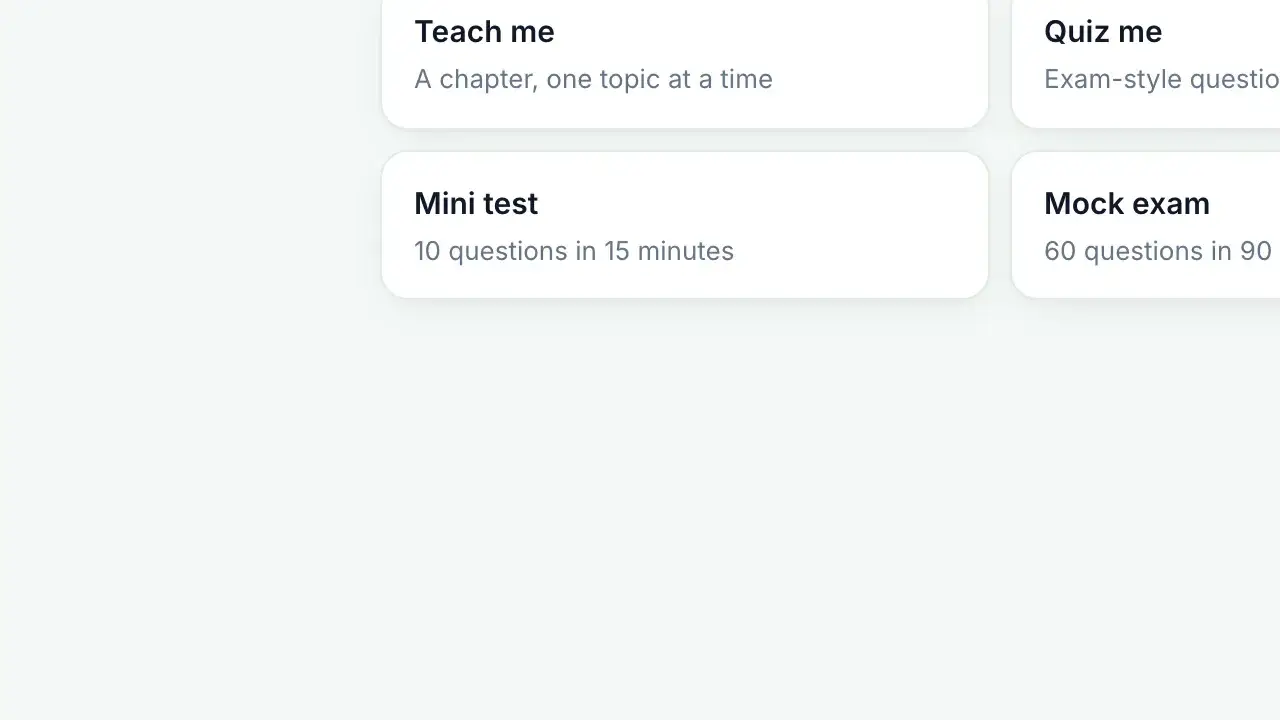
In our Revision Courses, an add-on with any case study packInside every objective test course. Teach me, quiz me, a mini test, or a mock of 60 questions in 90 minutes, like the real one.
Inside every objective test courseWe have helped thousands of learners on every CIMA route. Pick the one that sounds like you. Each path starts with something free.
OCS, MCS/Gateway or SCS. Pre-seen and industry analysis, timed mocks with professional marking, FinnAI and live classes.
See the case study packsNine OT courses built on our own notes, each with TutorBot to teach, quiz and mock you.
No objective tests to book. You pass a short assessment for each topic, in the same style as the OTs, then sit the same case study as everyone else. TutorBot helps with the first part; our pre-seen analysis, marked mocks and FinnAI with the second.
How FLP worksStart with the optional Certificate in Business Accounting (BA1 to BA4), or skip it with a degree. See what CIMA costs and the quickest route for your background.
What is CIMA? Find your route in 2 minutesAn accounting degree or another qualification can exempt you from exams, sometimes straight to the case study.
See what you can skipGPAP takes active ICAI and ICMAI members to CIMA's Strategic Case Study, then ACMA and CGMA.
How GPAP works CIMA after CASee the CIMA route open to SAICA members and what it means for your exams.
CIMA for SAICA membersEmployers, universities and training firms: CIMA tuition for your people, with progress reporting.
Every pack includes FinnAI, pre-seen and industry analysis, professionally marked mocks and our lifetime pass guarantee.
Study in your own time
Most chosen
Learn live with a group
Private sessions with a tutor
Doing a whole level? The Complete Bundle puts the case study pack and all three objective test courses together, with the Revision Course free.
Every mock is timed like the real exam and marked by a professional. This is a real marked mock from our November 2026 Operational Case Study course, shared without the student's name.
What the student was asked, word for word.
Rafael Ortega, Production Director, is considering introducing a new digital costing and materials management system at Tendra. The system would provide more up-to-date information on material costs and usage and would integrate information across purchasing, production and finance. Rafael believes that the system could improve Tendra’s management of production costs and raw materials. I have obtained information about the proposed system and compared this with Tendra’s current arrangements. This is shown in Table 1 (attached). Please prepare a briefing paper for the management team which:
Discusses how the features of the proposed digital costing and materials management system could benefit Tendra.
10 marksThe management team is also reviewing Tendra’s working capital management. I have calculated budgeted and actual working capital ratios for the five months to 30 November 2026. These are shown in Table 2 (attached). Please also include in your briefing paper:
An interpretation and explanation of the working capital cycle information in Table 2, including what it indicates about Tendra’s actual working capital position compared with budget, the potential effect on cash flow and any limitations of the information available.
7.5 marksRecommendations for actions Tendra could take to shorten its actual working capital cycle without disrupting production or damaging relationships with customers and suppliers.
7.5 marksTable 1: Digital costing and materials management information
| Proposed system | Tendra (current) | |
|---|---|---|
| Cost information | Real-time | Updated periodically |
| Standard cost updates | Can be updated when costs change | Reviewed annually |
| Supplier links | Automated | No automated links |
| Material usage tracking | Real-time | Limited |
| Demand and materials forecasting | AI-supported | No AI used for materials planning |
| System integration | Purchasing, production and finance integrated | Limited integration |
Table 2: Working capital information (days)
| Budget | Actual | |
|---|---|---|
| Inventory days | 70 | 84 |
| Trade receivable days | 20 | 27 |
| Trade payable days | 60 | 51 |
| Working capital cycle | 30 | 60 |
The student's whole answer, with the marker's notes beside the sentences they are about.
The student's answer
The marker's notes GoodNeeds workHow to think
The new digital costing system would give Tendra real-time information on material costs, rather than having to rely on information that may already be out of date.
This would help management spot changes in costs quickly and make better decisions about pricing, margins and production costs.
Standard costs could also be updated whenever there is a significant change in material prices, rather than waiting for the annual review1.
1Good, this directly uses the fact that Tendra currently reviews standard costs only annually, so real-time updates are a genuine improvement for this company specifically.
This should make Tendra’s variance analysis more useful, as managers would be comparing actual costs with more realistic standards.
The automated supplier links would mean purchase orders, delivery details and price changes could be transferred directly into the system, reducing manual work and the risk of errors.
Using existing barcode information would allow Tendra to see how materials are being used2 during production and identify areas where there may be waste or inefficient usage.
2Nice, ties the feature to Tendra's own existing barcode system in production rather than describing the feature in the abstract.
The AI demand and material forecasting feature could use past sales, seasonal trends and current orders3 to give Tendra a better idea of how much material it will need in the future.
3Good link to Tendra's known seasonal demand pattern, which makes AI forecasting more useful for this company than a generic statement would show.
Bringing purchasing, production and finance onto one integrated system would also mean that departments have access to the same information, which should improve communication and decision-making.
The system would cost T$420,000 but is expected to save T$110,000-T$150,000 a year, giving a payback of around 2.8 to 3.8 years4, although Tendra should also consider implementation and training costs before making a final decision.
4Needs workA calculation is fine but this point isn't one of the three strongest feature-benefit points, so it wasn't separately credited - better to spend that space developing one of the stronger points further.
Tendra’s working capital cycle has increased from the budgeted 30 days to 60 days5, which means significantly more cash is likely to be tied up in the business.
5Correctly identifies the key movement required by the task.
Inventory days have increased from 70 to 84 days, suggesting that Tendra is holding stock for longer than expected. This could be due to over-ordering, weaker demand or slower production, and it means Tendra’s cash is tied up in inventory for an additional 14 days.
Receivable days have also increased from 20 to 27 days, so Tendra is taking longer to turn sales into cash. Although 27 days is still below the 30-60 day payment terms offered to retail6 customers, Tendra should check whether some customers are paying later than agreed or whether there are delays in invoicing.
6Good, ties the receivable days figure to Tendra's actual retailer credit terms rather than just stating the number.
Payable days have fallen from 60 to 51 days, meaning Tendra is paying suppliers earlier7 than budgeted and therefore cash is leaving the business sooner.
7Correct interpretation of the direction and its cash effect.
However, the ratios alone do not show the actual amount of cash involved, and the five-month period may also be affected by seasonality8, so the reasons behind the movements need to be investigated.
8Needs workThis is the right point but it's only one line - a stronger answer would explain that these five months (June to November) sit across Tendra's peak and into its quieter season, so inventory and receivables figures may not reflect the full-year picture.
How to thinkExpand this into its own paragraph: explain what seasonality specifically does to each ratio (e.g. inventory may look high now because production continues evenly while sales have started dropping off after the summer peak) rather than mentioning it in passing.
Tendra could reduce its raw material inventory by improving its purchasing and demand forecasting, so that materials are ordered closer to when they are actually needed.
Work-in-progress could be reduced by identifying bottlenecks in production and improving production processes so that materials spend less time waiting to be processed.
Finished goods inventory could also be reduced by using customer orders and demand forecasts to avoid producing more goods than are likely to be sold in the short term.
Tendra could negotiate longer payment terms with its suppliers9, which would increase payable days and reduce the amount of time cash is tied up in the working capital cycle.
9Sensible and directly addresses payable days.
However, Tendra should negotiate rather than simply delay payments, as it has long-term relationships with its certified sustainable suppliers that it does not want to damage10.
10Good use of Tendra's own supplier relationships to justify negotiating rather than just delaying payment.
Tendra could improve receivables collection by invoicing customers promptly11, following up overdue accounts and reviewing the credit terms given to slower-paying customers.
11Practical and specific action rather than a vague statement about "managing receivables".
A mark for every part, and the marker's view of the whole answer.
19/25A pass
Overall assessment
You scored 19/25, which is a solid pass - well done. Your structure is genuinely strong across all three parts: you organised points clearly, covered everything the task asked for (all three working capital areas in part (c), all four ratios in part (b)), and you didn't waffle. That's a real strength and it's worth holding onto.
Where you lost marks was depth of application, not knowledge. In part (a) you correctly picked out the right features from Table 1 and gave a benefit for each, but most benefits stayed generic - "helps management make better decisions" could apply to almost any company. The marker wants you to push one layer further and tie the benefit to something unique about Tendra, like its three ranges with very different cost structures or its seasonal demand pattern. You did this well in a couple of places (AI forecasting linked to seasonality), which shows you can do it - you just didn't do it consistently.
Part (b) was close to strong but you rushed the cash flow and limitations discussion into one sentence when the task specifically asked for it. That's where marks were sitting. Part (c) had a similar issue - three of your inventory points were really one idea repeated rather than three distinct, fully developed recommendations. Picking one and really working through the Tendra detail would have scored better than three shallow ones.
What to do differently in the next mock.
After every point, force yourself to write one more sentence starting "for Tendra specifically..." - name the range, the ratio, or the fact from the scenario that makes this point matter here and not at any other company.
When a task explicitly names two things to cover (e.g. "cash flow implications AND limitations"), give each its own clearly separate paragraph with a specific figure, not one line that nods at both.
If you're repeating the same idea across multiple bullets (like three inventory types), stop and merge them into one bullet - then use the time saved to develop that single point properly with reasoning and a Tendra fact.
Before finishing an answer, check your benefit/impact statements aren't generic enough to apply to any business - if a sentence could sit in any company's answer unchanged, rewrite it with a number or fact from the case.
Watch or attend the live classes and submit your homework for marking. If you do not pass, your next exam window is free, and the one after that, with no expiry.
From our Trustpilot reviews, quoted as written.
“I then switched to another tutor for my SCS and unfortunately failed. I returned to FinnTutors for my rewrite and passed!”
“Helped me pass the MCS exam after failing using only what is provided in the FLP. Great value for money, and instant support over WhatsApp.”
“Hands down one of the main reasons why I passed all three case studies the first time, as well as being a joint first award winner for MCS.”
“the thing that really sets them apart from other providers is the FinnAI service.”
“Dev and the team are fantastic and helped me to get 115 in the OCS.”
“follow the course, do all the mocks, take advantage of Finn Ai developed by Finn, do your homework and go with confidence to the exam.”
People in more than 100 countries prepare for their CIMA exams with us. Every case study course includes our WhatsApp community, where you share tips, ask questions and keep each other going with others sitting the same exam.


Pick your exam to see its free mini course, case map, guide and past questions.
Not sure where to start, what you can skip or what it costs? Answer a few questions and we will show you your likely route.
Your background, the exams you can likely skip, and the fees, in plain words.
We explain your options and the documents CIMA needs. In India, we send your documents to CIMA's India office, which confirms your route.
Register with CIMA, then start your first course with us, from the objective tests to the case study.
Learn the pre-seen company and its industry well, then practise writing timed answers and get them marked. Most of the marks come from applying ideas to the company, so marked mocks with clear feedback make the biggest difference. Our free mini course is a good place to start.
FinnAI is our assistant for case study students, trained on our own pre-seen and industry analysis for your sitting. It answers questions about the company, the numbers and exam technique in seconds, and can set and mark practice questions. It sits alongside your lead tutor, not in place of one.
Watch or attend the live classes and submit your homework for marking. If you do not pass, you get free access for your next exam window, and the one after that, with no expiry.
On Demand gives you the recordings, timed mocks with professional marking, FinnAI and the pre-seen analysis to study in your own time. Full Case Study adds live classes twice a week and more marked mocks. 1:1 Coaching adds ten private sessions.
Yes. Our case study mock questions have the same time limits as the real exam, so you practise under exam conditions. TutorBot's objective test mocks are timed too: 60 questions in 90 minutes, like the real one.
Within 48 hours. Each mock is marked against CIMA's grid, with a mark for every part, comments on your answer and a summary of what to work on next.
Yes. Many of our students come through exemptions or CIMA's Finance Leadership Program. RevisionBot, in our Revision Courses, teaches the E, P and F ideas the case study draws on, one topic at a time. It is an add-on with any case study pack.
Yes. We have courses for all nine objective tests (E1 to F3), each with our own notes, video lessons and TutorBot to teach and test you.
Yes. Finntutors is a CIMA Global Learning Provider and has won CIMA's Global Pass Rate Excellence Award four years running, from 2022 to 2025.
Three days of case study prep, with a mini mock marked by a professional.

Get started today before this once in a lifetime opportunity expires.